Autonomous Trucking Giant PlusAI Clears SEC Hurdle, Poised for Public Debut: What It Means for Fleet Operations and CDL Drivers
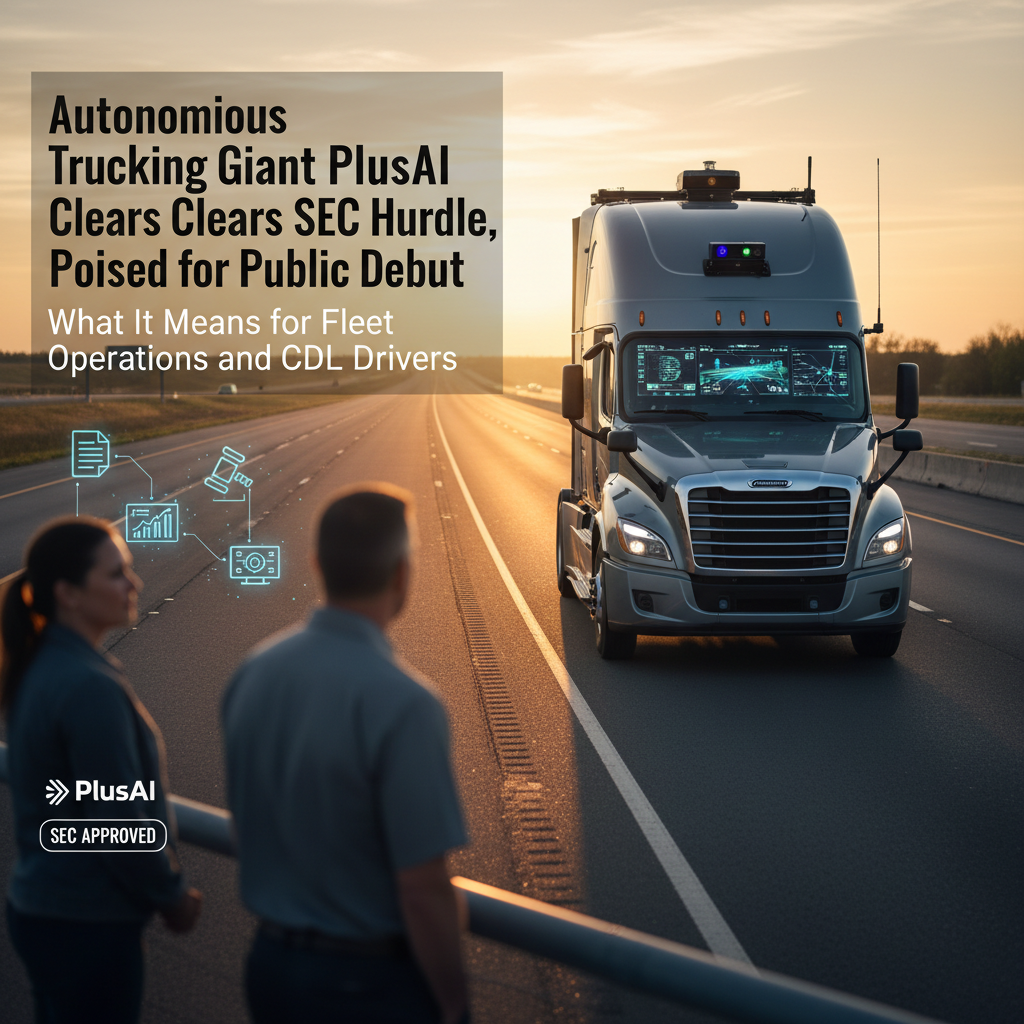
Autonomous Trucking Giant PlusAI Clears SEC Hurdle, Poised for Public Debut: What It Means for Fleet Operations and CDL Drivers
The landscape of commercial trucking is undergoing a profound transformation, driven largely by advancements in autonomous technology. One of the key players shaping this future, PlusAI, an autonomous trucking technology provider, is nearing a critical milestone in its corporate journey: becoming a publicly traded company. Following months of intensive regulatory review, PlusAI has successfully cleared the Securities and Exchange Commission (SEC) hurdle for its merger with Churchill Capital Corp IX, setting the stage for a potential public debut in February 2026.
This move is far more than just a financial transaction; it signals a significant acceleration in the commercialization timeline for Level 4 autonomous trucking systems. For fleet managers planning future capital expenditures and CDL professionals navigating their careers, understanding these developments is crucial. This comprehensive analysis breaks down PlusAI’s path to the public market, the technology validation, and the practical implications for the trucking industry.
The Road to Public Markets: SEC Clearance and the SPAC Merger
PlusAI, headquartered in Silicon Valley, has been working diligently toward bringing its autonomous driving software to market. The company’s planned entry into the public sphere is being facilitated through a Special Purpose Acquisition Company (SPAC) merger with Churchill Capital Corp IX. This strategy allows private companies to go public more quickly than a traditional Initial Public Offering (IPO).
The merger agreement was initially announced in June 2025. However, the critical step in this process was navigating the rigorous review by the SEC. According to PlusAI CEO David Liu, the company spent six months working through the regulatory requirements for its S-4 filing—a massive, 800-page document detailing the company's business plan, financial health, and regulatory disclosures. The declaration that the S-4 filing was ‘effective’ in late January 2026 marked the successful completion of this phase, paving the way for a shareholder vote scheduled for February 3, 2026.
Liu emphasized that 2026 represents a significant “inflection point” for the company. The regulatory clearance validates the company's structure and transparency, giving potential investors, and perhaps more importantly, future fleet customers, confidence in PlusAI's long-term viability. While the typical SEC review process for such filings takes about three months, PlusAI’s extended timeline highlights the complexity and scrutiny involved in bringing disruptive, safety-critical technology like autonomous trucking to the public market.
Strengthening Leadership for Commercial Scale
Transitioning from a startup focusing solely on technology development to a publicly traded entity requires robust corporate governance and experienced leadership. Recognizing this necessity, PlusAI strategically bolstered its board of directors ahead of the public listing.
In early January 2026, PlusAI announced the appointment of two highly experienced executives to its board, effective upon the company’s public debut: David C. Peterschmidt and Harry J. Harczak, Jr. These additions are designed to reinforce financial stewardship and operational scaling—areas vital for a company preparing for widespread commercial deployment.
David C. Peterschmidt brings deep expertise in scaling technology companies, having previously served as COO for Sybase and CEO for Inktomi. His track record includes taking companies public and growing them significantly, a skill set crucial for PlusAI as it moves toward mass production and deployment. Harry J. Harczak, Jr., a former senior partner at PricewaterhouseCoopers LLP and former CFO of CDW (which he also took public), will serve as the audit committee chair. His financial acumen ensures the company adheres to the stringent reporting and compliance standards required of a public entity.
For fleet managers, the quality of a technology partner’s leadership directly impacts reliability and long-term support. The addition of seasoned veterans signals PlusAI’s commitment to building a stable, well-governed company capable of supporting large-scale commercial contracts and maintaining the trust of the trucking industry.
Technology Validation and the Path to Commercial Deployment
While the financial maneuvers secure the company’s future funding, the core value proposition for the trucking industry lies in the technology itself. PlusAI is not just building software; it is building a system designed to integrate seamlessly into existing fleet operations, initially focusing on long-haul routes where autonomous technology offers the greatest efficiency gains.
PlusAI has been actively validating its autonomous driving technology through strategic partnerships with major global truck manufacturers, including Volkswagen’s Traton Group. This partnership encompasses the International brand in the United States, as well as Scania and MAN in Europe. These collaborations are crucial because they ensure the technology is developed with OEM-level integration and reliability, a non-negotiable requirement for high-utilization commercial vehicles.
Key Performance Metrics Driving Trust
To track progress and build confidence among regulators and customers, PlusAI monitors specific, measurable performance indicators. These metrics provide tangible evidence of the system’s maturity:
- Safety Case Readiness: This metric measures the technology’s ability to handle all identified safety-critical scenarios. Over the 12 months leading up to the announcement, PlusAI reported a significant improvement of over 15 percentage points, reaching 90% readiness. This figure is paramount for fleet safety officers and insurance providers, demonstrating that the system is rapidly approaching the necessary robustness to operate safely on public highways.
- Remote Assistance Free Trips (RAFT): This metric tracks the percentage of miles driven without requiring intervention or assistance from a remote operator. The RAFT rate increased to 79%, up from 76.2% in the first half of 2025. A higher RAFT percentage indicates greater autonomy, fewer operational interruptions, and ultimately, higher efficiency and lower operational costs for fleets.
These metrics underscore the company’s focus on reliability and safety—the two pillars upon which the adoption of autonomous trucking will stand or fall. The continuous improvement in these areas is a strong indicator that the technology is maturing rapidly toward commercial viability.
Targeting 2027: The Commercialization Timeline
For fleet managers eager to integrate autonomous capabilities, the timeline for availability is the most critical piece of information. PlusAI is targeting 2027 as the year when autonomy-enabled trucks will be available to customers. This timeline aligns with many industry predictions for the widespread deployment of Level 4 autonomous technology on specific, mapped highway corridors.
This commercialization target means that fleets should begin their strategic planning now. Integrating autonomous trucks is not simply a matter of purchasing new equipment; it requires:
- Infrastructure Adaptation: Modifying yards and maintenance facilities to support new technology.
- Workforce Planning: Developing training programs for technicians who will maintain these complex systems and creating new roles for remote supervisors and dispatchers.
- Route Selection: Identifying the optimal lanes and freight types that maximize the benefits of autonomous operation, typically long-haul, hub-to-hub movements.
Implications for CDL Drivers and Fleet Operations
The rise of autonomous trucking, epitomized by companies like PlusAI reaching public maturity, generates both excitement and apprehension within the trucking community. It is essential to frame this technology not as a replacement for the professional driver, but as a revolutionary tool that redefines the driver’s role and enhances overall operational efficiency.
The Evolving Role of the CDL Professional
While Level 4 autonomy handles the highway driving portion, human drivers remain indispensable for the complex, low-speed maneuvers required in terminals, city streets, and customer docks (the “first mile” and “last mile”). The future model is likely to involve:
- Transfer Hub Operations: Drivers specializing in short-haul, regional, or local routes, handling the truck from the distribution center to the highway transfer hub, where the autonomous system takes over.
- Supervisory Roles: Highly skilled CDL holders transitioning into roles as autonomous vehicle supervisors, monitoring fleets remotely, or serving as safety drivers during initial deployment and challenging weather conditions.
- Increased Regional Focus: Autonomous systems are expected to alleviate the pressure on long-haul drivers, potentially increasing the demand for regional and dedicated route drivers who can be home more frequently.
For current CDL holders, this shift emphasizes the value of specialized skills—particularly those related to complex maneuvering, customer interaction, and potentially, familiarity with new vehicle monitoring systems.
Operational Benefits for Fleet Managers
For fleet managers, the successful public listing and subsequent commercial deployment of PlusAI’s technology offer compelling economic advantages:
- Improved Utilization: Autonomous trucks can operate nearly 24/7, limited only by maintenance and fueling schedules, significantly boosting asset utilization compared to human-driven trucks restricted by Hours-of-Service (HOS) regulations.
- Fuel Efficiency: Autonomous driving systems utilize predictive algorithms and precise control over acceleration and braking, leading to optimized speed profiles and measurable fuel savings.
- Safety Enhancement: The focus on “Safety Case Readiness” indicates a technology designed to eliminate human error, which is responsible for the vast majority of severe accidents. This potential for enhanced safety translates directly into lower insurance costs and reduced liability.
- Addressing the Driver Shortage: By automating the less desirable long-haul segments, fleets can better allocate their human resources to regional routes, helping to mitigate the persistent driver shortage challenge.
Actionable Takeaways for the Industry
As PlusAI moves closer to its public debut and 2027 commercial launch, the trucking industry must prepare for this technological shift. Here are practical steps for fleet managers and professional drivers:
For Fleet Managers:
- Start Pilot Programs Now: Engage with technology providers or OEMs partnered with firms like PlusAI (e.g., Traton Group) to understand integration requirements and operational impacts.
- Invest in Data Infrastructure: Autonomous trucks generate massive amounts of data. Ensure your fleet management systems (FMS) and IT infrastructure are ready to handle, analyze, and leverage this data for predictive maintenance and performance optimization.
- Develop a Workforce Transition Plan: Identify which current roles will evolve and what new technical skills (e.g., diagnostics for autonomous systems) will be required for your maintenance staff.
For CDL Drivers:
- Embrace Technology Training: Seek out opportunities to train on advanced driver-assistance systems (ADAS) and new vehicle technologies. Familiarity with these systems will be a key differentiator.
- Focus on Regional Expertise: The demand for skilled regional and local drivers handling complex urban environments will likely increase. Sharpening these skills ensures long-term career relevance.
- Monitor Industry Trends: Stay informed about which fleets are adopting autonomous technology and what new roles (e.g., remote monitoring operator) are emerging, positioning yourself for career advancement in the evolving logistics sector.
PlusAI’s successful navigation of the SEC process and imminent public listing is a powerful indicator that autonomous trucking is rapidly transitioning from a futuristic concept to a near-term reality. The financial stability and enhanced governance resulting from this move will accelerate the deployment of safe, efficient autonomous systems, fundamentally reshaping the economics and operational strategies of the trucking industry by the end of the decade.
Helpful Resources for CDL Drivers
Comments (0)
Sign in to join the conversation
Sign In to CommentNo comments yet. Be the first to share your thoughts!
Explore More
Driver Resources
Educational guides on CDL licensing, salary expectations, and route planning tips.
Browse CDL Jobs
Find your next driving opportunity. Search by location, route type, and CDL class.
CDL Salary Guide
Understand how pay varies by experience, route type, and location in the trucking industry.