
The Autonomous Middle Mile: How Driverless Medium-Duty Trucks Are Reshaping Regional Logistics and What It Means for CDL Professionals
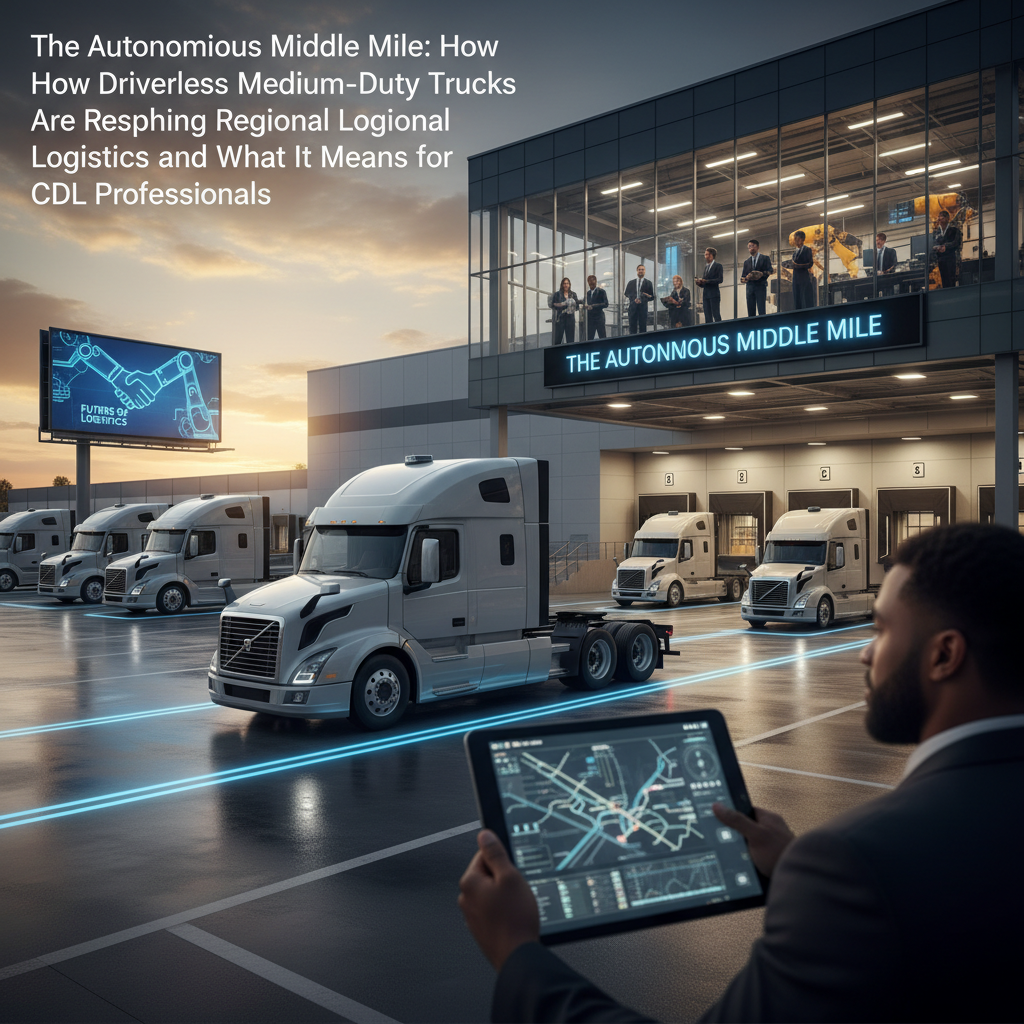
The Autonomous Middle Mile: How Driverless Medium-Duty Trucks Are Reshaping Regional Logistics and What It Means for CDL Professionals
The landscape of commercial transportation is undergoing a rapid, fundamental transformation driven by autonomous vehicle technology. While much of the public discourse focuses on Class 8 autonomous long-haul trucking, a significant revolution is quietly unfolding in the 'middle mile' segment, involving medium-duty trucks (typically Class 3 through Class 7). Recent developments confirm that autonomous medium-duty trucks are no longer a futuristic concept but a fully operational reality, running 24 hours a day, seven days a week, without a human driver or supervisor onboard, across major logistics hubs in Texas, Arizona, and Arkansas.
This shift, spearheaded by companies like Gatik, marks a critical inflection point for the industry. For CDL professionals, fleet managers, and logistics executives, understanding the scope, scale, and implications of this technology is paramount. It dictates future job roles, operational efficiencies, and investment strategies in the years to come.
The Rise of Driverless Medium-Duty Operations
Autonomy in the medium-duty sector focuses primarily on fixed, repetitive routes—the 'middle mile' logistics that bridge distribution centers, fulfillment centers, and retail locations. This is distinct from the complex, unpredictable environment of last-mile delivery or the long-haul interstate corridors.
Core Facts and Scale: The company Gatik has successfully transitioned its operations to full commercial scale, utilizing 26-foot and 30-foot autonomous box trucks. These vehicles are currently integrated into the supply chains of multiple Fortune 50 retailers, executing daily deliveries without human intervention. The operational footprint spans high-volume areas, including the Dallas–Fort Worth Metroplex, the Phoenix Metro area, and Northwest Arkansas.
Crucially, this is not a pilot program. Gatik reported reaching a staggering $600 million in contracted revenue for these daily driverless deliveries. Furthermore, the company has completed over 60,000 fully driverless commercial orders without incident since launching freight-only operations in mid-2025. This consistency and reliability in real-world logistics networks validate the commercial viability of autonomous technology in this specific segment.
As Gautam Narang, CEO and co-founder of Gatik, stated, "Autonomous trucking is no longer a promise. It’s a business." This sentiment underscores the transition from experimental technology to a core operational asset for major retailers and Consumer Packaged Goods (CPG) companies.
Why Medium-Duty Autonomy is Taking the Lead
While Class 8 long-haul autonomy faces hurdles related to extreme weather, complex interstate regulations, and the sheer unpredictability of open-road driving, medium-duty operations benefit from inherent structural advantages:
1. Fixed, Predictable Routes: The middle mile involves routes between known points (e.g., DC to store). These routes are often shorter, geographically constrained, and highly repeatable. This predictability allows the autonomous driving system (ADS) to learn the route intimately, minimizing exposure to novel situations and maximizing safety.
2. Controlled Operational Design Domain (ODD): The ODD for these operations is typically restricted to specific highways and surface streets within defined urban or regional boundaries. This controlled environment simplifies the sensor requirements and decision-making processes for the ADS compared to cross-country travel.
3. Immediate ROI for Retailers: For large retailers, the most acute supply chain bottleneck often occurs between the regional distribution center and the final store location. This segment suffers from high driver turnover and inconsistent scheduling. Driverless operations provide 24/7 capacity, ensuring shelves are stocked faster and more reliably, directly impacting sales and inventory management. The ability to run continuously, day and night, without mandated rest breaks, dramatically increases asset utilization.
4. Regulatory Alignment: Operating primarily within state lines and on established commercial routes often simplifies the regulatory pathway compared to complex, multi-state Class 8 operations.
The Impact on CDL Truck Drivers: Adaptation, Not Elimination
For the professional CDL driver community, the introduction of driverless medium-duty trucks raises natural questions about job security and the future of the profession. However, industry experts largely agree that this technology represents a shift in demand, not a wholesale replacement of human drivers.
Focus Shift to Long-Haul and Complex Local: The driver shortage remains a critical issue, particularly in long-haul trucking and specialized local deliveries (e.g., construction, bulk hauling, specialized last-mile). By automating the repetitive, predictable middle-mile routes, the industry can potentially reallocate human drivers to areas where their unique skills—such as complex maneuvering, customer interaction, problem-solving in unpredictable environments, and handling specialized equipment—are indispensable.
New Roles Emerging: Autonomy creates new, high-tech jobs that require CDL expertise combined with technical skills:
- Remote Operators/Supervisors: Monitoring autonomous fleets from a control center, ready to take over remotely if the ADS encounters an edge case it cannot resolve.
- Autonomous Vehicle Technicians: Specialized mechanics and diagnostic experts needed to maintain the complex sensor arrays, computing hardware, and software systems of autonomous trucks.
- First and Last-Mile Drivers: Human drivers will remain essential for the non-automated segments of the journey, such as maneuvering through tight urban areas, backing into docks, and interacting with facility staff.
Actionable Takeaway for Drivers: CDL holders should view this as an opportunity to upskill. Seeking training in vehicle diagnostics, telematics, and potentially even remote operations can position drivers for higher-paying, technically focused roles within the evolving logistics ecosystem. The demand for skilled drivers capable of handling complex, non-standard routes will likely intensify.
Implications for Fleet Managers and Logistics Executives
Fleet managers must strategically integrate autonomous technology to maximize efficiency and maintain a competitive edge. This requires a calculated approach to investment, infrastructure, and workforce planning.
1. Maximizing Asset Utilization: The primary commercial benefit of driverless operations is the ability to run 24/7. Fleet managers can achieve significantly higher utilization rates (potentially doubling daily operational hours) compared to human-driven routes constrained by Hours-of-Service (HOS) regulations. This means fewer trucks are needed to move the same volume of freight, optimizing capital expenditure.
2. Infrastructure Investment: Implementing autonomous fleets requires specific infrastructure adjustments at distribution centers and hubs. This includes dedicated autonomous vehicle parking, high-precision mapping maintenance, and robust, secure communication networks (5G or equivalent) to ensure continuous connectivity for remote monitoring and software updates.
3. Optimized Route Planning: Fleet managers will need to work closely with ADS providers to define and maintain the Operational Design Domain (ODD). This involves meticulous route mapping, identifying potential hazards, and establishing clear protocols for handoffs between human and autonomous segments of the journey.
4. Safety and Data Management: While Gatik reports 60,000 incident-free driverless orders, safety remains paramount. Fleet managers must establish rigorous safety protocols, including redundant systems and comprehensive data logging. The data generated by autonomous trucks—related to driving behavior, system performance, and route efficiency—offers unprecedented insights for continuous operational improvement.
5. Workforce Transition Strategy: Fleet managers must develop a clear strategy for transitioning their current medium-duty drivers. This includes offering opportunities for retraining into technical support roles, reallocating drivers to specialized or long-haul Class 8 divisions, or leveraging their expertise in supervisory and training capacities for the new autonomous operations.
Geographical Expansion and Future Outlook
While the current focus is heavily concentrated in the Sun Belt states (Texas, Arizona, Arkansas) due to favorable weather and regulatory environments, the expansion of medium-duty autonomy is already underway.
-
Nebraska and Ontario, Canada: Gatik has also deployed commercial operations in Nebraska and Ontario, Canada, albeit at a smaller scale initially. These deployments demonstrate the technology’s adaptability to different regulatory frameworks and climate conditions, signaling a broader geographical rollout.
-
The Hub-to-Hub Model: The success of the middle-mile model confirms that the most immediate and profitable application of autonomy is in structured, hub-to-hub logistics. This model is highly scalable and applicable to any major metropolitan area with high-volume retail or e-commerce distribution networks.
The next phase of development will focus on integrating these autonomous middle-mile operations seamlessly with both the long-haul network and the final human-driven last-mile delivery. This requires standardized communication protocols and efficient transfer points (or 'transfer hubs') where freight can be quickly moved between autonomous medium-duty trucks and human-operated vehicles.
Regulatory Landscape and Industry Collaboration
The rapid deployment of driverless technology necessitates proactive engagement with regulators. State and federal agencies are increasingly recognizing the need to create clear frameworks for autonomous commercial vehicle operations. The trucking industry, through organizations like the American Trucking Associations (ATA), is actively participating in these discussions to ensure that safety standards are maintained while innovation is encouraged.
For fleet managers, staying abreast of evolving state-level legislation regarding autonomous vehicle testing, deployment, and liability is crucial. The patchwork of state laws currently governing AVs is one of the primary challenges to seamless nationwide scaling.
Conclusion: Adapting to the Autonomous Era
The successful deployment of 24/7 driverless medium-duty trucks in major US logistics corridors is a powerful testament to the maturity of autonomous vehicle technology in specific operational domains. For CDL drivers, this signals a shift toward roles requiring greater technical skill and specialized knowledge, reinforcing the value of human judgment in complex logistics. For fleet managers, it presents an immediate opportunity to dramatically increase operational efficiency, reduce labor costs on repetitive routes, and future-proof their supply chains.
Autonomous trucking is no longer a distant promise; it is a current business reality generating hundreds of millions in contracted revenue. The industry must now focus on strategic integration, workforce adaptation, and regulatory harmonization to fully capitalize on this technological leap, ensuring that the future of logistics is both highly efficient and fundamentally safe.
Helpful Resources for CDL Drivers
Comments (0)
Sign in to join the conversation
Sign In to CommentNo comments yet. Be the first to share your thoughts!
Explore More
Driver Resources
Educational guides on CDL licensing, salary expectations, and route planning tips.
Browse CDL Jobs
Find your next driving opportunity. Search by location, route type, and CDL class.
CDL Salary Guide
Understand how pay varies by experience, route type, and location in the trucking industry.